
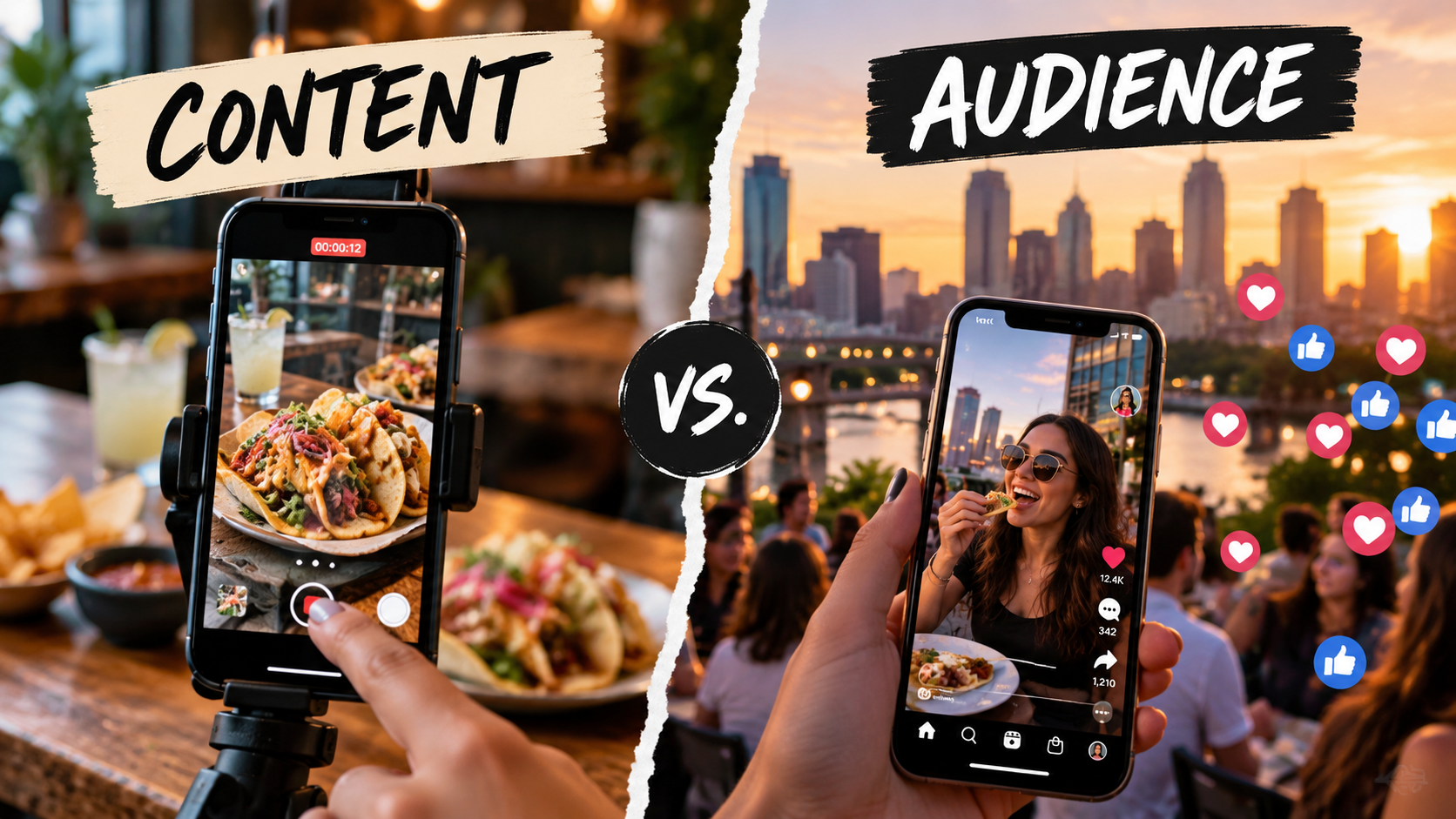
A creator walks into a local restaurant, films the food, captures the atmosphere, edits everything into a 30-second Reel, and delivers a polished video.
Is that UGC or influencer marketing?
The answer depends less on what the video looks like and more on what the business is actually getting from the creator.
That distinction matters. A business looking for more social media content may not need to pay for access to a creator’s audience. And a business trying to reach new customers may need more than a great video sitting on its own Instagram account.
Before working with a creator, start with a simpler question:
Do you need content, distribution, or both?
WHAT IS INFLUENCER MARKETING?
Influencer marketing generally uses a creator’s relationship with an existing audience to help promote a business, product, or experience.
The creator might visit a restaurant, try a product, attend an event, or use a service and then share that experience with their followers.
That means the business isn’t evaluating only the content. The creator’s audience matters too.
Businesses considering an influencer partnership may want to look at the type of people who regularly interact with the creator’s content, where that audience is located, whether the creator’s usual subject matter fits the business, and whether their audience is relevant to the people the business actually wants to reach.
For a local restaurant, for example, a smaller creator with a highly relevant local audience may be more useful for a local promotion than a much larger creator whose followers are scattered around the country.
The video matters, but distribution is part of what the business is paying for.
WHAT ABOUT UGC?
UGC traditionally means user-generated content: content created by customers or users rather than the brand itself.
The term is also commonly used today for creator-made content produced for brands, even when the creator doesn’t have a large audience.
In that type of arrangement, the creator’s ability to make useful content can matter more than their ability to distribute it.
A creator might produce:
• a product demonstration • a restaurant experience • a testimonial-style video • an unboxing • a talking-to-camera video • a product close-up • a short-form vertical ad • lifestyle footage featuring the business
Depending on the agreement and usage rights, the business may then use that content on its own social channels, website, advertising, or other marketing.
The creator may never post the video to their own audience at all.
THE SIMPLEST DIFFERENCE: CONTENT VS. DISTRIBUTION
The distinction becomes easier when you separate two things a creator can provide.
Content is the actual marketing asset: the footage, editing, storytelling, hook, demonstration, or finished video.
Distribution is access to the creator’s audience.
Influencer marketing can provide both.
UGC-style creator work can focus primarily on the content.
Neither is automatically better. They solve different problems.
WHEN DOES INFLUENCER MARKETING MAKE MORE SENSE?
Consider influencer marketing when reaching the creator’s audience is an important part of your goal.
Imagine a new restaurant trying to introduce itself to people who regularly look to local food creators for recommendations.
In that situation, the restaurant isn’t simply interested in getting another video.
It also wants people to see that video through the creator.
Audience relevance therefore becomes important.
Follower count alone still doesn’t tell the entire story. A business should consider whether those followers are actually relevant to the business and its location.
A large audience that has little connection to your potential customers may be less useful than a smaller but highly relevant one.
WHEN DOES CREATOR-MADE CONTENT MAKE MORE SENSE?
Now imagine that same restaurant already has an Instagram account, website, email list, and advertising budget.
Its problem isn’t necessarily reaching someone else’s audience.
Its problem might simply be:
We don’t have enough good content to publish ourselves.
That’s a different problem.
A restaurant might need footage of a new menu item.
A gym might need several vertical videos showing what its classes actually feel like.
A salon might want before-and-after content.
A retailer might need short product demonstrations.
A local attraction might want videos showing what the experience actually looks like.
In those situations, follower count may be far less important than whether the creator can make something the business genuinely wants to use.
SOMETIMES YOU NEED BOTH
Businesses don’t always have to choose between content and distribution.
Sometimes the best arrangement provides both.
A business might want a creator to make a strong piece of content and publish it to their audience.
That can make sense.
The important part is recognizing that you’re receiving two different forms of value and evaluating each accordingly.
If distribution matters, ask whether the creator’s audience is relevant.
If the content asset matters, evaluate the quality and usefulness of the work.
If both matter, evaluate both.
This distinction can also make comparing creator opportunities easier because two creators charging similar amounts may actually be offering very different things.
DON’T JUDGE CONTENT CREATORS ONLY BY FOLLOWER COUNT
One mistake businesses can make is treating follower count as a universal measurement of creator value.
Someone can have a small audience and still be excellent at filming food.
Another creator might be great at hooks and short-form storytelling.
Someone else may understand how to make a product look appealing on camera.
Another might be particularly good at capturing the atmosphere of a physical location.
Those skills can have value even when the creator doesn’t have thousands of followers.
If you’re purchasing content rather than distribution, ask questions such as:
Would I actually post this?
Does this look and feel like my business?
Does the opening make me want to keep watching?
Does it show the product or experience clearly?
Could I realistically use this in my marketing?
Those questions may tell you more about the value of the content than the creator’s follower count.
KNOW WHAT RIGHTS YOU’RE GETTING
There’s another distinction businesses shouldn’t overlook: having a video made doesn’t automatically mean every possible use of that video is included.
Before paying for creator content, understand what the agreement allows.
There can be a meaningful difference between permission to publish content organically on your social accounts and permission to use that same content in paid advertising.
Businesses should understand the applicable usage rights, duration, platforms, exclusivity, and restrictions before assuming a creator asset can be used everywhere indefinitely.
The same applies to influencer partnerships.
If you think you may eventually want to turn a creator video into an advertisement, put it on your website, reuse it months later, or incorporate it into another campaign, understand whether your agreement allows that.
THINK IN TERMS OF A CONTENT LIBRARY
For businesses that need content consistently, another useful shift is to stop thinking about every video as an isolated social post.
Think about building a library of usable marketing assets.
A restaurant, for example, could eventually have content showing:
• individual dishes • drinks • atmosphere • the patio • behind-the-scenes preparation • customer experiences • seasonal items • staff personalities • different occasions to visit
A gym could build a library around classes, equipment, instructors, beginner experiences, facilities, member routines, and different workout styles.
A retailer could build one around individual products, demonstrations, new arrivals, gift ideas, comparisons, and seasonal collections.
Not every piece needs to come from the same creator.
Different creators can interpret the same business differently, giving the business a wider range of material to work with.
That changes the question from:
Who is the perfect influencer for my business?
to:
What kinds of content does my business actually need?
A DIFFERENT MODEL WE’RE TESTING IN AUSTIN
Most creator arrangements begin before the content exists.
A business finds a creator, discusses what it wants, agrees on the work, and then the creator produces the content.
At AdLulu, we’re currently testing a different approach in Austin.
Participating businesses provide creators with general content preferences, filming rules, and the maximum amount they may be willing to pay for a video.
Creators independently decide which participating businesses they want to create for. They make finished content and choose their own price within the business’s maximum.
The business gets to see the finished video and its price before deciding whether to purchase it.
The business can purchase it, save it for later, or pass.
There’s no guarantee that every creator video will sell, and businesses aren’t obligated to purchase everything created for them.
That uncertainty is intentional.
Our Austin test is designed to find out whether a marketplace for finished local creator content can work between real creators and real businesses.
START WITH WHAT YOUR BUSINESS ACTUALLY NEEDS
UGC-style content and influencer marketing aren’t interchangeable, and businesses don’t necessarily have to choose one forever.
Start with the objective.
If you need access to someone’s audience, evaluate their ability to distribute.
If you need marketing assets for your own channels, evaluate their ability to create.
If you need both, structure the relationship around both.
Knowing what you’re actually trying to buy makes everything that comes afterward easier.
AdLulu is currently preparing its Austin marketplace test with local businesses and creators. Learn more about participating at AdLulu.com.